The UK digital economy has emerged as one of the most significant national growth engines, generating over £150 billion annually and supporting a workforce that extends well beyond the core technology sector. With over 1.7 million people employed directly in digital roles, and up to 5 million when considering digitally enabled jobs across the wider economy, the digital sector represents both a cornerstone of productivity and a critical driver of future competitiveness.
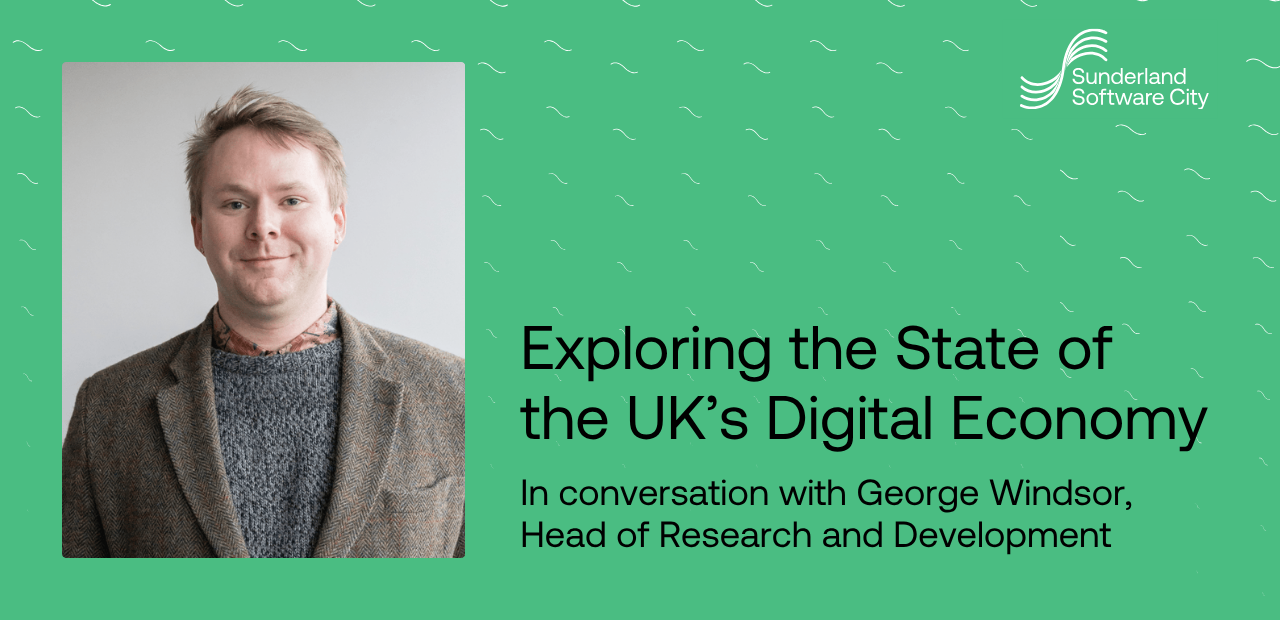
However, whilst headline indicators remain strong, the underlying dynamics of the digital economy are becoming increasingly complex. Growth is no longer linear, nor is it confined to traditional digital sectors. Instead, it is being shaped by interconnected regional ecosystems, evolving infrastructure demands, and the rapid advancement of technologies such as artificial intelligence. Drawing on the expertise of George Windsor, Head of Research and Development at Sunderland Software City, this article explores how these shifts are redefining the UK digital economy, and what is required to ensure sustainable growth across all UK regions.
Importance of a Digital Network
Over the past decade, the UK has built a global reputation for excellence in digital innovation, particularly in areas such as software, fintech, and creative technologies. Yet the nature of this success is evolving. Growth within the digital economy is increasingly non-linear and deeply networked. Rather than emerging in isolation within individual cities or regions, high-growth companies are now shaped by connections between clusters of talent, capital, and organisations across the UK.
This shift has important implications for how economic development is understood and supported. It is no longer sufficient to invest in individual places in isolation. Instead, the focus must be on strengthening the connections between regions, enabling knowledge, resources, and opportunities to flow more effectively, to allow for a stronger UK digital economy as a whole.
The work of Sunderland Software City and the UK Tech Cluster Group provide a clear example of this approach in practice. One such programme is the DSIT-funded programme, the Regional Tech Booster, which aims to demonstrate the impact of regionally led, nationally connected support for tech ecosystems across the UK. Early outcomes from this programme demonstrate that when regions are linked more effectively, the impact is considerable. By creating a network, opportunities can be identified more quickly, learnings can be shared and businesses can scale more easily.
Shift to Physical Infrastructure
Alongside this shift towards networked growth, the digital economy is undergoing a more fundamental transformation. Previous decades have been dominated by software and cloud-based business models, however thanks to the rise of tools such as artificial intelligence, there is now a growing emphasis on physical infrastructure to underpin digital innovation. This ‘re-materialisation’ of technology reflects the increasing importance of compute power, data infrastructure and the shift in focus to digital sovereignty.
As digital systems become ever more integral to economic and national resilience, the ability to build, manage and control digital infrastructure is becoming a strategic priority. This presents a significant opportunity for the UK, and for regions like the North East of England.
Recent developments in the North East, such as the emergence of the North East AI Growth Zone and the proposed large-scale data centre in Blyth, demonstrate the scale of this opportunity. These initiatives have the potential to bring in new industries, attract investment, and create many high-value job roles. For these developments to effectively harness all of these benefits, it is essential for regional stakeholders to coordinate effectively to translate strategic ambition into tangible outcomes.
Barriers to Growth
Despite the UK’s strong position, several structural challenges continue to limit the full potential of the digital economy in some places. One of the most persistent issues for those outside of the capital is the concentration of capital within London and the South East of England. While the UK attracts significant levels of investment overall, the distribution of that capital remains uneven. High-potential companies in other regions often struggle to access the funding required to scale, particularly at later stages of growth.
Another challenge lies in the age old relationship between talent and opportunity. The UK produces a steady pipeline of highly skilled technical professionals in fields such as computer science and engineering. However, regions like the North East frequently struggle to retain this talent. Young professionals are often drawn to locations, such as London, where opportunities are more visible or where there is a stronger concentration of high-growth firms. Read more about the national and regional digital talent pipeline here.
Ecosystem fragmentation is also a significant barrier. While many regions benefit from strong individual initiatives and centres of excellence, these are not always effectively connected to one another. This can result in duplication of effort across the UK, missed opportunities to collaborate, and a lack of shared learning across the system. Importantly, these challenges are not indicative of a lack of capability but rather a need for greater co-ordination.
Future Growth Opportunities
Looking ahead, several technology areas are expected to have a transformative impact on the UK economy. Artificial intelligence is perhaps the most prominent, particularly in its application to specific sector challenges. In healthcare, AI is enabling more accurate diagnostics and improved patient outcomes. In manufacturing, it is driving efficiencies through automation and robotics. In enterprise environments, it is supporting rapid problem-solving and the development of new digital tools.
The emergence of companies such as Cogna, which uses AI to build software solutions for traditional industries, demonstrates how these technologies are reshaping even the most established sectors. Rather than creating entirely new markets, AI is often enhancing existing ones, unlocking productivity gains and enabling new forms of value creation.
At the same time, growth in areas such as climate technology, cybersecurity, and data infrastructure reflects both market demand and global necessity. These sectors are closely aligned with national priorities, including the transition to net zero and the need for greater digital resilience. The UK is well positioned to capitalise on these opportunities, but doing so will require coordinated investment and a clear focus on regional strengths.
How Sunderland Software City is Driving Digital Economic Growth
Sunderland Software City occupies a unique position within the UK’s digital landscape, combining strategic insight with practical delivery. Our work spans digital adoption, business growth support, skills and talent development, ecosystem creation and more, enabling us to influence both individual organisations and the broader system in which they operate.
Through our digital adoption programmes, we support organisations to explore, derisk and adopt technologies such as artificial intelligence, data analytics, and automation into their strategies. This not only enhances productivity but also creates opportunities for innovation within sectors that may not traditionally be considered part of the digital economy. In doing so, Sunderland Software City helps to ensure that the benefits of digital transformation are felt across the wider economy.
In its support for startups and scaleups, we provide access to networks, funding opportunities, and expert guidance. By connecting founders with the resources they need, Sunderland Software City helps to accelerate growth and improve the likelihood of long-term success.
Perhaps most importantly, Sunderland Software plays a central role in ecosystem development. By acting as a connector between industry, government, and academia, we enable more effective collaboration and ensures that regional strengths are fully leveraged. Our ability to translate complex challenges into practical solutions positions it as a key partner in shaping the future of the UK digital economy.
For organisations seeking to navigate the complex digital economy, Sunderland Software City offers both strategic guidance and practical delivery, transforming insight into real-world impact.
About George Windsor
George Windsor is Head of Research and Development at Sunderland Software City, where he leads strategic insight and evidence‑led work that helps shape understanding of the UK digital economy and regional tech ecosystems.
With a distinguished career spanning academic research, public policy and high‑growth tech strategy, George’s expertise is grounded in both theory and practical impact. He completed a PhD at Loughborough University, where his research examined highly skilled migration and entrepreneurship in the UK. George later founded and expanded the Research and Data teams at Tech Nation, the UK network for ambitious tech startups, and has worked with investors and ecosystem partners to develop evidence that accelerates scaling companies and informs policy. His breadth of experience uniquely positions him to analyse complex digital economic trends and translate them into actionable strategic insight for businesses, policymakers and regional growth initiatives.
Conclusion
The UK’s digital economy is entering a new phase, characterised by increased complexity, deeper interconnectivity, and a growing reliance on physical infrastructure. Whilst the UK remains to be a global world leader in technology, sustaining this success will require a more coordinated and regionally inclusive approach to growth.
Regions such as the North East have a critical role to play in this future. With strong research institutions, industrial heritage, and emerging digital capabilities, they are well placed to contribute to the next wave of innovation. However, realising this potential will depend on the ability of stakeholders to work collaboratively, address structural barriers, and align their efforts around shared objectives.
Through its leadership, expertise, and delivery capability, Sunderland Software City is already demonstrating what this approach can look like in practice. By connecting ecosystems, supporting businesses, and driving innovation, it is helping to ensure that the UK’s digital economy continues to grow in a way that is both sustainable and inclusive.
If you would like to continue this conversation, or need support with any of the topics indicated in this article, please get in touch with our team by emailing: info@sunderlandsoftwarecity.com