Digital inclusion is no longer a secondary social issue or a niche policy concern. It is now a fundamental societal challenge that directly affects the UK’s technology sector and impacts our ability to grow, innovate and deliver equitable access to opportunities.
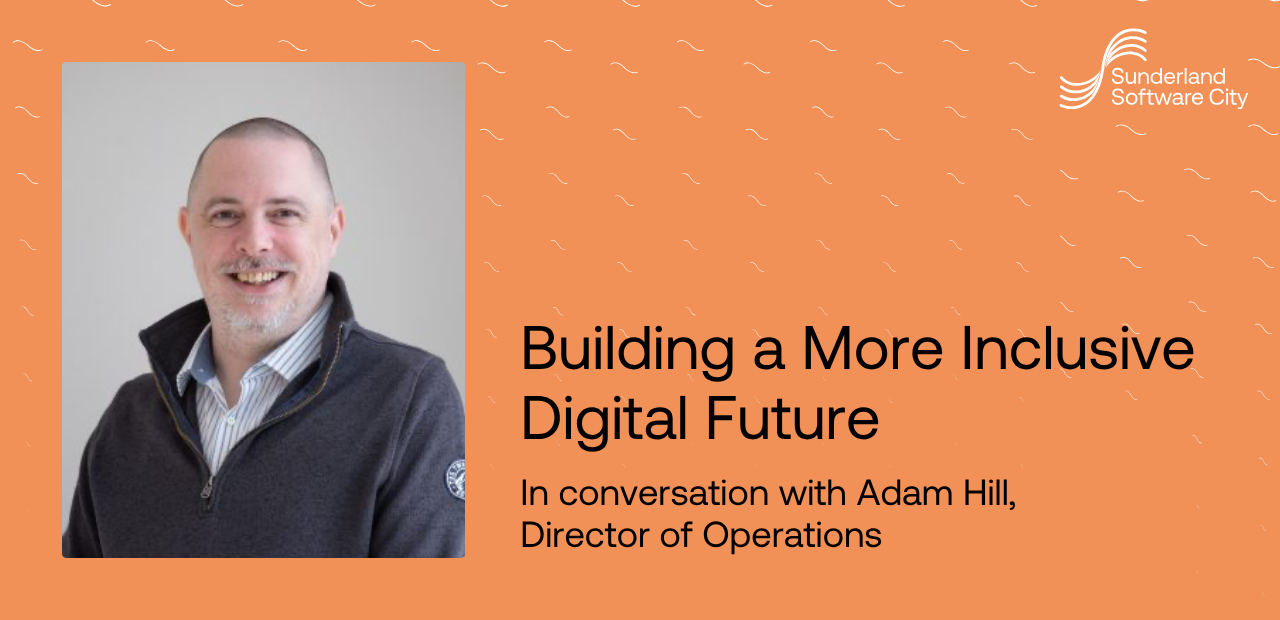
From structural barriers to practical steps, this article draws on the expertise of Adam Hill, Director of Operations at Sunderland Software City and member of the UK Government’s Digital Inclusion Action Committee at the Department of Digital, Culture and Sport, to explore the current state of digital inclusion in the UK.
Digital Inclusion Across the UK
Digital exclusion does not exist in isolation. It is deeply connected to broader inequalities around income, education, health, geography, and employment. And, whilst digital access and capability are often discussed as though they are universal, the data paints a very different picture. The UK Government’s Digital Inclusion Action Plan shows that millions of people still lack access to basic digital devices and connectivity, with somewhere between 1.1 million and 3.4 million UK households lacking access to a smartphone, affecting at least 3.4 million adults.
Those that do have access to digital devices do not always choose to engage online. Ofcom’s Adults’ Media Use and Attitudes Report found that only 62% of digitally included adults access public-service information through government websites leaving approximately 22 million people who do not have the confidence, skills or desire to engage digitally with public systems.
This lack of capability is a large issue. The Lloyds Essential Digital Skills Report found that approximately 8% of UK adults, do not possess the essential digital skills needed for everyday life, such as communicating safely online and accessing digital services. In a reflection of this, the same report found that 9% of adults cannot complete online forms required to access essential services, including registering to vote, booking GP appointments or ordering repeat prescriptions (The Lloyds Digital Skills Index).
Digital Exclusion as a Social and Economic Issue
The Government’s Digital Inclusion Action Plan identifies a wide range of groups that may be digitally excluded, including people on low incomes, older adults, individuals with disabilities or neurodivergence, care leavers and young people not in education, people experiencing homelessness, individuals with limited English, refugee and migrant communities, survivors of domestic abuse, rural communities with poor connectivity, and individuals who lack confidence or trust in digital technologies. It is important to note that these groups are not an exhaustive list, and for many individuals, digital exclusion compounds existing challenges.
Older adults remain one of the clearest examples. Age UK research found that nearly 5.8 million people aged over 65 are either unable to use the internet safely and successfully or are not online at all. Additionally, 37% of over-65s who want to use the internet more report that they do not trust it. Digital exclusion in this demographic is often framed purely as a skills issue, but confidence, safety and trust play equally critical roles. Many individuals are reluctant to engage digitally because they fear scams, data misuse, privacy breaches or simply making mistakes. As more essential services move online, these concerns become increasingly significant.
Clearly, the challenge of digital inclusion is extremely multi-faceted, extending beyond digital infrastructure and into trust, confidence, skills and accessibility. As many organisations shift towards digital-first services, this creates a significant risk of exclusion for millions.
Moving Towards a More Inclusive Digital Future
Good digital inclusion is about giving people the access, skills, confidence and support they need to use technology independently and safely. Whilst there is certainly no ‘one size fits all’ approach, there is increasingly strong evidence that effective intervention can deliver measurable change. As connectivity and infrastructure has increased, the issue has become more nuanced, and with deeper links to existing inequalities.
Good Things Foundation is the UK’s leading digital inclusion charity. During 2022, Good Things Foundation delivered a pilot Digital Skills Partnership programme with the combined authorities in Greater Manchester, West Midlands, and North of Tyne (now part of the North East Mayoral Combined Authority). This programme supported 5,347 digital excluded adults and found that 94% of participants felt that their digital skills had improved, 92% felt more confident using the internet, 86% felt safer online and 79% of the participants were motivated to keep on learning.
The benefits do not end there and there is a compelling economic case. The Good Things Foundation’s Digital Nation report estimates that improving digital skills for life could generate a £13.7 billion benefit to the UK economy, while improving digital skills for work could deliver a £23 billion economic boost. Research also indicated that people with high levels of digital engagement save an extra £1,100 per year.
This evidence suggests that the definition of successful digital inclusion needs to move beyond simple measures of participation. The more meaningful interventions see individuals able to grow and achieve long after the support provided. For example, can they apply for a job, access public services, manage their finance or stay safe online? These are some of the measures that demonstrate genuine digital inclusion.
In recent years, the UK has made progress. Ofcom research has suggested that The UK’s digital divide narrowed during the coronavirus pandemic, as people went gone online to escape the lockdown. In March 2020, it was estimated that 11% of homes did not have access to the internet, but just two years later, this had fallen to just 6% of homes. The challenge is now keeping up the momentum and ensuring that this number falls even further.
For organisations, becoming more digitally inclusive starts with recognising that inclusion needs to be designed into services, products and workplaces, rather than added in as an afterthought. This means understanding the different barriers people may face and designing around them. For example, providing accessible and mobile-friendly services, using clear and plain language, ensuring that websites and platforms work with assistive technologies, and retaining telephone, face-to-face or other offline routes where digital cannot reasonably meet someone's needs. Organisations should also consider whether their employees, customers or users have access to devices, connectivity or skills required and provide practical support or signpost to trusted organisations.
Importantly, this should not be treated as the sole responsibility of an organisation's tech or digital team. Digital inclusion works best when it becomes part of culture, with leaders considering inclusion when designing services, procuring technology, training staff and engaging customers or communities. This can include training employees to act as digital champions, working with community partners to reach people who may not engage directly with the organisation, and regularly testing services with people who have different levels of digital confidence and ability.
Digital Inclusion in the North East
There is important work going on to reduce digital exclusion across the North East. In 2024 local authorities formed the Minimum Digital Living Standard Task Group, actively working together to look at infrastructure, services and capability. Additionally, Sunderland’s “Go Online Sunderland” programme has been nationally recognised as an example of best practice, and initiatives in partnership between Gateshead Council and Connected Voice have brought support from the Digital Poverty Alliance and other national, regional and local partners. Tess Valley Combined Authority have invested in a Digital Inclusion Feasibility study with local partners and Durham University have recently concluded work supported by the Digital Inclusion Innovation Fund. Dynamo North East have also been driving the involvement of the technology sector having successfully raised over £100k in the last two years for the Dynamo Digital Inclusion Fund. All of these steps are pushing towards a more digitally inclusive region, something that must continue into the future.
How Sunderland Software City is Supporting Digital Inclusion
Sunderland Software City is supporting digital inclusion by connecting access, skills and opportunity. Through programmes such as Sunderland Digital Careers, Sunderland Software City helps young people understand the range of digital careers available and the pathways into them. Digital Skills Bootcamps provide adults with employer-led training to develop skills aligned with demand, while Tech Talent Pro gives people practical work experience and a route into employment.
Working with local partners in the VCSE sector, Sunderland Software City has provided digital adoption support to over 50 charities in Newcastle, Gateshead and North Tyneside, helping them progress projects that directly reduce digital exclusion in these areas. This work is ongoing in this area with the Digital Pathfinders project that has supported over 100 additional VCSE organisations over the last five years. This year we have two pilots with the Lighthouse Project in Byker, and WWIN in Sunderland looking at digital inclusion with young people and domestic abuse survivors.
Alongside this, Sunderland Software City works with businesses, education providers and regional partners to identify skills needs and develop practical solutions. The team also host regular events with local partners to help organisations develop the knowledge and skills to become more inclusive. This convening role can help organisations design more inclusive routes into digital skills and employment, particularly for people who face barriers to accessing traditional pathways.
About Adam Hill
Adam Hill, Director of Operations at Sunderland Software City, is a digital leader and entrepreneur with more than 25 years’ experience helping people and organisations use technology to create positive change. Adam is a Digital Inclusion Action Committee Member for the Department of Digital, Culture, Media and Sport, sits on the board of Trustees for VONNE (Voluntary Organisations' Network North East) and also acts as an external advisor for the Digital Transformation Board at Together for Children, where he brings his expertise in both the digital and the voluntary, community and social enterprise sectors.
Adam joined Sunderland Software City in 2020 as Head of Digital Adoption, leading programmes designed to help businesses and organisations across the North East adopt and embed digital technologies. His work has consistently focused on the understanding that digital transformation is ultimately about people and behaviour as much as technology, with effective adoption having the potential to improve productivity, reduce inequality and create new opportunities.
Alongside his work at Software City, Adam has played an active role in developing the region's wider digital ecosystem. He founded multiple groups such as Open Source North East, Tech for Good North East and the No-Code North East community to make technology development more accessible beyond traditional technology specialists, and has supported initiatives focused on technology, digital inclusion and social impact. Adam is a regular speaker on digital transformation, technology and civil society, and has worked with organisations across the public, private and voluntary sectors to explore how technology can be used more effectively and inclusively.
To Conclude
Digital inclusion is about ensuring that everyone has the access, skills, confidence and support to participate in an increasingly digital society. For organisations across the North East and beyond, the message is clear: digital inclusion cannot be treated as a standalone social issue and should be addressed through cross-sector collaboration. The future of digital will depend not only on the technology we introduce, but on whether people have the capability, desire and confidence to use it. Creating meaningful access to digital skills, building trusted pathways into support and ensuring that no community is left behind must therefore be embedded as part of the wider digital growth agenda.
Sunderland Software City is uniquely positioned to support this journey. If you are interested in discussing how we could work together, please get in touch by emailing us at: info@sunderlandsoftwarecity.com