Over three days, postgraduate students, researchers and recent graduates from across the North East came together at Hope Street Xchange in Sunderland for the NortHFutures Design & Innovation Sprint. More than just a design sprint, the event challenged participants to think differently about one of healthcare’s most poignant issues: how creative technology can help to improve children and young people’s mental health.
The sprint was part of the Northern Health Futures (NortHFutures) Hub which is funded by UK Research and Innovation and the Engineering & Physical Sciences Research Council. It is a collaborative digital health hub bringing together universities, NHS trusts and over 50+ core partners.
Run by Sunderland Software City and driven by Newcastle University and University of Sunderland, the sprint brought together a unique mix of healthcare professionals, designers, technologists and students to tackle real-world challenges using a human-centred design approach. Rather than building apps or writing code, participants focused on understanding people, exploring lived experiences and designing meaningful solutions grounded in empathy and evidence. Participants gained hands-on experience in design thinking, problem solving, collaboration and presentation skills while creating portfolio-ready work to help them with their future careers.
3-Day Design & Innovation Sprint
The first day immersed participants in the realities of children and young people's mental health services. Through insights from clinicians, practitioners and lived experience, teams developed a shared understanding of the challenges facing young people, their families and healthcare professionals. These conversations laid the foundations for identifying opportunities where creative and emerging technologies could make a genuine difference. Thank you so much to the Centre for Life, Nebula Labs, Strange Quark and CPI Lab that were able to join us.
Day two shifted the focus towards creativity and collaboration. Using practical design thinking techniques, the teams built user personas, mapped healthcare journeys, identified friction points and explored how technologies could improve healthcare. Part of the day was spent getting inspired by immersive experiences and cutting-edge technologies from organisations such as Divergence and XR Therapeutics.
On the final day, ideas evolved into well-developed concepts. Teams refined their proposals with support from expert mentors from Newcastle University, considering not only innovation but also ethics, feasibility, safeguarding and implementation. Each group presented their concept to an expert judging panel, demonstrating how thoughtful design and collaboration can generate practical solutions to complex healthcare challenges.
The winning idea was called CircleUP, a multi-lingual tool that helps students that have English as a second language to learn through live text-to-speech and gamified missions. The trio, Peter, Innocent and Alex, met at the sprint and have now gone on to seek further support to build their solution into a real-world tool that can be used.
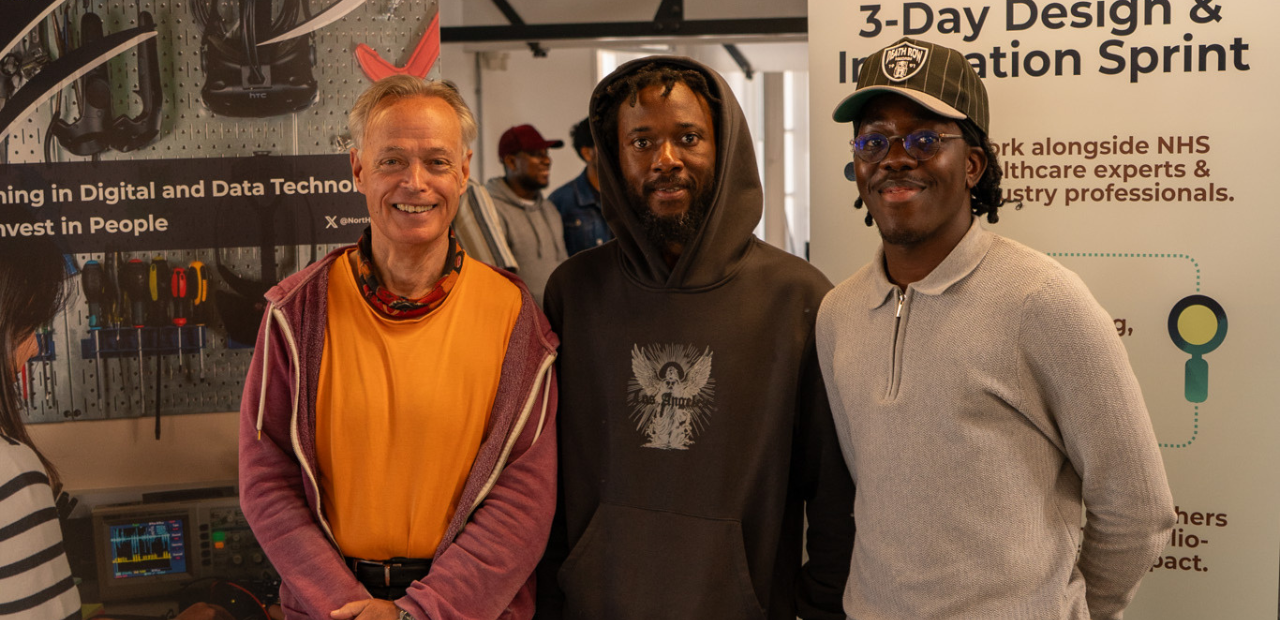
“Taking part gave me valuable experience in turning research and user insights into a practical solution while collaborating and working under time pressure. Developing CircleUp, a school-supported digital platform designed to help newly arrived children communicate, build confidence and feel included, showed me how thoughtful design can address real social challenges. Winning means a great deal to me because it validates the idea and has given me greater confidence to continue developing it beyond the Sprint. My main takeaway is the importance of keeping users at the centre of the design process and testing ideas early.”
- Innocent Opara
“I was scared of the Sprint, due to my age and definitely not being tech savvy. I brought ideas and experience of young people in crisis. Most of the other participants on the Sprint were very tech savvy and much younger. We all worked together, exchanging ideas, advice and knowledge, pooling together for a common aim of finding solutions. My gain was to be immersed in a tech environment which welcomed my input and worked with me. It was liberating.”
- Peter Hardy
“Taking part in the NortHFutures Design & Innovation Sprint was one of the most enjoyable and rewarding experiences I've had. It challenged me to think creatively, work closely with a fantastic team, and develop solutions to real world problems in a short space of time. I came away with new skills, greater confidence, and a real appreciation for the power of collaboration. The biggest lesson I'll take forward is that the best ideas come from listening to different perspectives and building on each other's strengths. I'll always remember the energy, teamwork, and sense of achievement from the Sprint, and I'm grateful to everyone involved for making it such a valuable experience.”
- Alex Ijesuorobo Idusuyi
Final Thoughts
The NortHFutures Design & Innovation Sprint demonstrated the power of bringing together people from different backgrounds to tackle real-world challenges. By placing people at the centre of innovation and encouraging curiosity and creativity, the event showcased how the next generation of researchers and innovators can help shape effective health services for children and young people.
If you would like to learn more about this sprint, please get in touch with Jenna Ingoe at: Jenna.Ingoe@sunderlandsoftwarecity.com