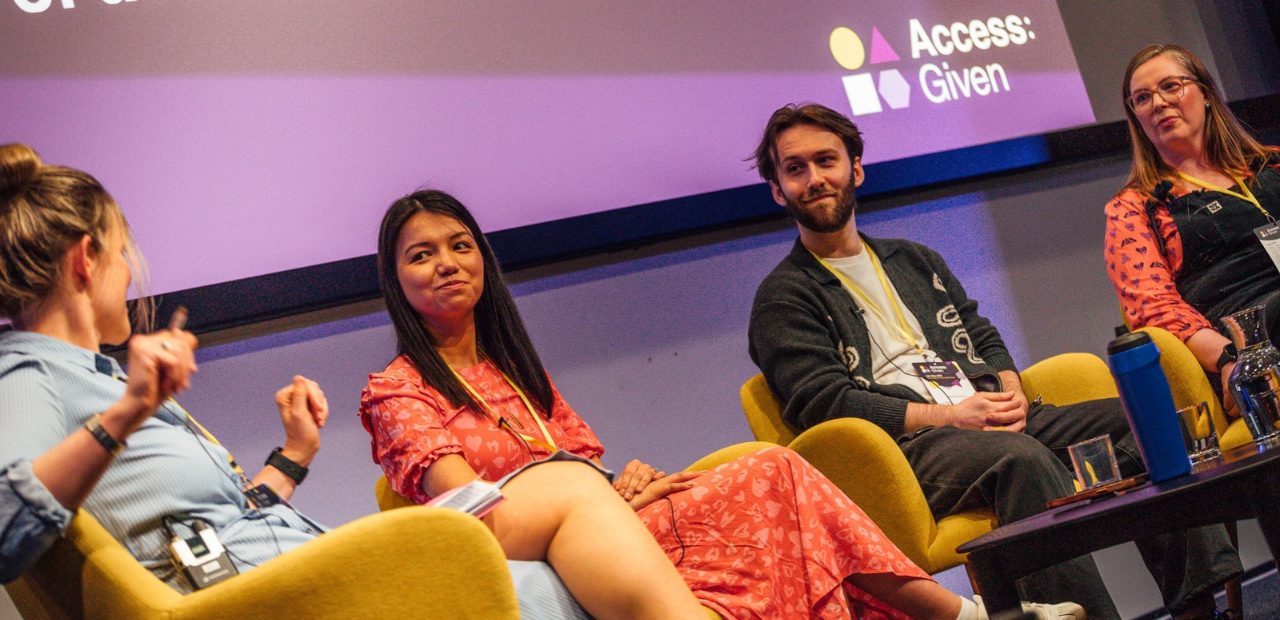
This last May I joined a panel at Access:Given 2026, the one-day digital accessibility conference held at the Catalyst in Newcastle, and I came away a little stunned by how much accessibility is already part of the everyday working life of the digital community here in the North East. I had been invited to talk about communicating the importance of accessibility to decision-makers, which I was happy to have opinions on, but I suspect I took far more out of the day than I put into it.
This was only the second Access:Given, the first having taken place in September 2025, and yet people had travelled in from across the country to be there, bringing a depth of expertise I would have expected from an event with a decade of history behind it. I'll come back to that, because to explain why it landed so hard with me I first need to admit how recently I arrived in this field.
Finding my feet in accessibility
Accessibility in service design is something I have only properly come to grips with over the past two or three years, as my work shifted towards helping companies and charities design the websites and interfaces their customers and service users rely on. In an blog post I wrote back in March (‘counting down to this year's conference’) I wrote that when I joined Sunderland Software City in 2021 digital accessibility seemed to live in a small box, filed somewhere between legal checklists and audits. Doing the work since then has shown me how small that box really was, because a decision about a form field or a button label turns out to be a decision about who gets through a service and who gets stuck halfway.
Much of my early reading in this area came from Lou Downe, who spent six years in the UK Government establishing cross-government standards for good services before founding the School of Good Services. Their book Good Servicessets out fifteen principles for designing services that work, and the one I kept coming back to was the eleventh, which says a good service should be usable by everyone, equally. That final word is the one that matters most, because it rules out the familiar compromise where a service is technically usable by everyone but noticeably harder for some people than for others.
Their recent sequel, Bad Services, swaps principles for diagnosis, setting out five causes of bad services and ways to fix them with or without buy-in. If you have ever watched a sensible idea run aground somewhere between a workshop and a budget meeting, you will recognise a lot of it, and the reading of these materials made for a very good primer for the subject of the panel I was about to sit on.
On the panel
Katie Thompson, a content writer and strategist, hosted our panel on communicating the importance of accessibility to decision-makers. Sharing the stage with me were Jo Larby, Accessibility Community Lead at Leighton, and Kim Anderson, a service design specialist and educator at the Service Design Academy. For someone who only started taking accessibility seriously a few years ago it was a humbling line-up to be part of, and I think I learned at least as much from listening to the others as I offered myself (hopefully).
The subject sounds simple until you try it, because the people who sign off budgets are rarely the people who meet the users a service shuts out, and the case for accessibility has to survive the journey between the two. I've argued before that when accessibility lives only in a defensive, compliance-driven corner it arrives late in a project and stays underfunded, and that the better question for anyone with sign-off is what changes when it is part of the strategy from the first day.
I said earlier that I'd come back to the expertise in the room, and the panel is where I felt it most. Accessibility in the North East is not standing at the edge of the conversation waiting to be invited in. Martin Underhill, who also spoke this year at Access:Given, has been talking about this exact subject matter since at least 2018, and that kind of steady local groundwork showed in an audience that was well past the basics. Add the people who had travelled from well beyond the region for an event in only its second year, and it was obvious that Access:Given had tapped into something a lot of people were already looking for.
What set Access:Given apart was how much of its subject you could feel in the room. The organisers had designed the day so that the things being argued for on stage were happening all around the audience at the same time, which turned what could have been a day of talking heads into something far more visceral.
A11y North and the question of AI
Off the back of Access:Given, I was invited to speak at A11y North, a Leeds-based meetup for accessibility and inclusive design professionals across the north of England, which held its second event in Newcastle In July.
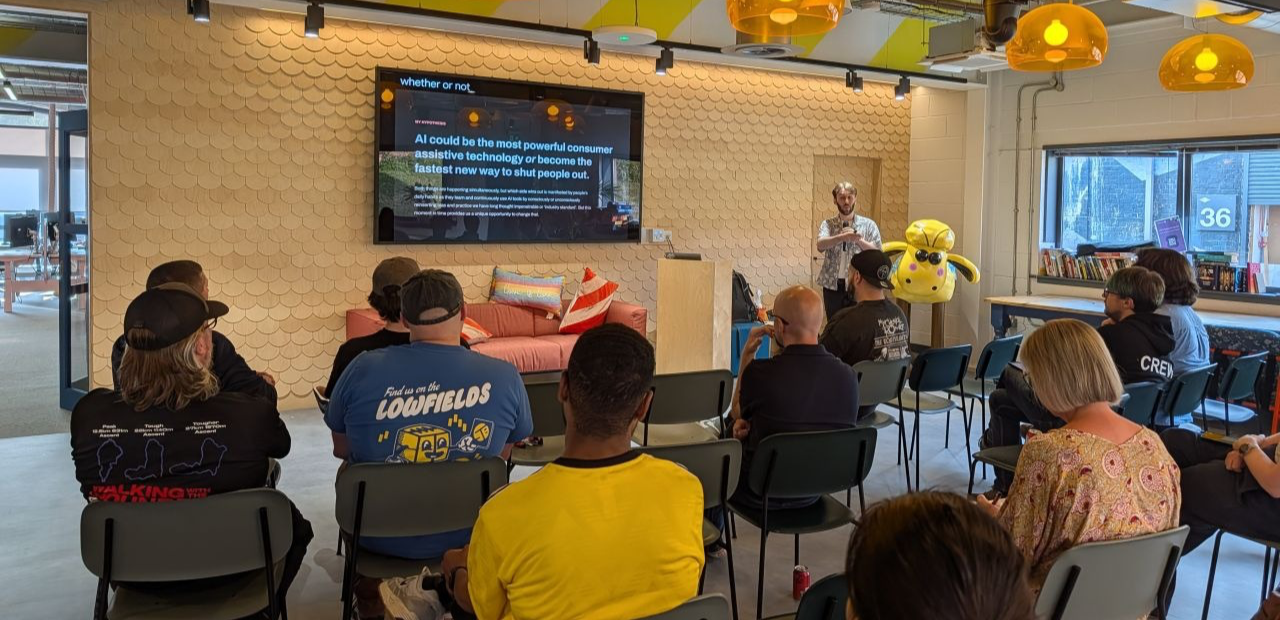
My talk was called ‘Accessibility in the age of AI Interfaces’. It drew on the last few years I've spent in user experience and front-end design for the web, mostly in software like Figma and Framer with regular detours into Adobe's apps and Canva, every one of which now has increasing amounts of AI generation built in somewhere. I wanted to look at how that shifts the goalposts about who can use the things we make.
My perhaps controversial statement to open my talk was thus:
“AI could become the most powerful consumer assistive technology we have ever had, or the fastest new way to shut people out, and that both of those futures are arriving at the same time. Which one wins out is not something the technology will decide on its own. It gets decided in our daily habits, in all the small moments where we accept what a tool hands us and, consciously or not, reinsert biases and practices we had long since stopped questioning because they looked like industry standard.”
To make that statement less abstract, think about where these tools picked up their habits. This year's WebAIM Millionfound detectable WCAG failures on 95.9% of the top million home pages, the first time in six years that the figure has got worse. If I ask an AI tool for a sign-up form and accept its first attempt, I am accepting the web's average habits, and those habits are not good. Multiply that by every designer and developer doing the same thing several times a day and you can see how old exclusions get re-entrenched faster than any audit cycle could catch them.
The hopeful half of the argument is that we may never get a better moment to change those habits. AI is rewriting so many of the conventions we took for granted, from how interfaces get built to how people find and use services, that the old defaults are suddenly up for negotiation. If accessibility is written into the prompts and review steps we are setting up now, it becomes the habit that gets repeated at scale.
At the end of my talk, there was one question I wanted people to leave with, so I'll hand it over to you dear reader as well… when the next AI tool lands on your desk, can you tell whether it includes people or locks them out, and will you remember to ask yourself that question?
Returning to Access:Given in 2027
I came away from both events with a huge amount of joy at seeing accessibility, and digital inclusion more broadly, given this kind of weight. People gave up a working Wednesday or a summer evening to sit in a room and talk about it, and the real value of that time comes afterwards, when they carry what they heard back into their own organisations and keep arguing for it there.
Some of those organisations run services nobody can really opt out of, whether that's an NHS booking system or the online banking and tax services we are all expected to manage for ourselves, and an inaccessible form in one of those can be the difference between getting help and going without. I mean, who amongst is shouting from the rooftops about how great scheduling a GP appointment is at the moment? On the other hand, you’ll find people building smaller things that fill the rest of our lives, like a community group's website or a charity's sign-up form, which counts equally as important, as these are these services which connect us to other people in our local lives.
So here is where I ask something of you. If you have a story to tell about how accessibility or digital inclusion has shaped your work, in digital services or anywhere else, the Access:Given website explains how to put yourself forward as a speaker, and you can follow the organisers on LinkedIn too. Encouraging people to get up and share what they know has become a bit of a shtick of mine, so consider yourself encouraged. If your organisation is in a position to help, the sponsorship page is worth a look too. As we all know, an event put together with this much care doesn't pay for itself.
Access:Given returns on Wednesday 28th April 2027, back at the Catalyst in Newcastle upon Tyne. If you find yourself there, come find me and say hello!